
Only 9 Days of Work Under MGNREGA on Average: Rural Economy in Distress as Tripura Faces Severe Employment Crisis
As of June 9, 2026, a total of 3,34,957 workers have received employment under the scheme. However, only 31,27,611 person-days of work have been generated, resulting in an average of just 9 days of employment per worker. This figure is far below the scheme's objective of providing up to 100 days of guaranteed wage employment per rural household annually.
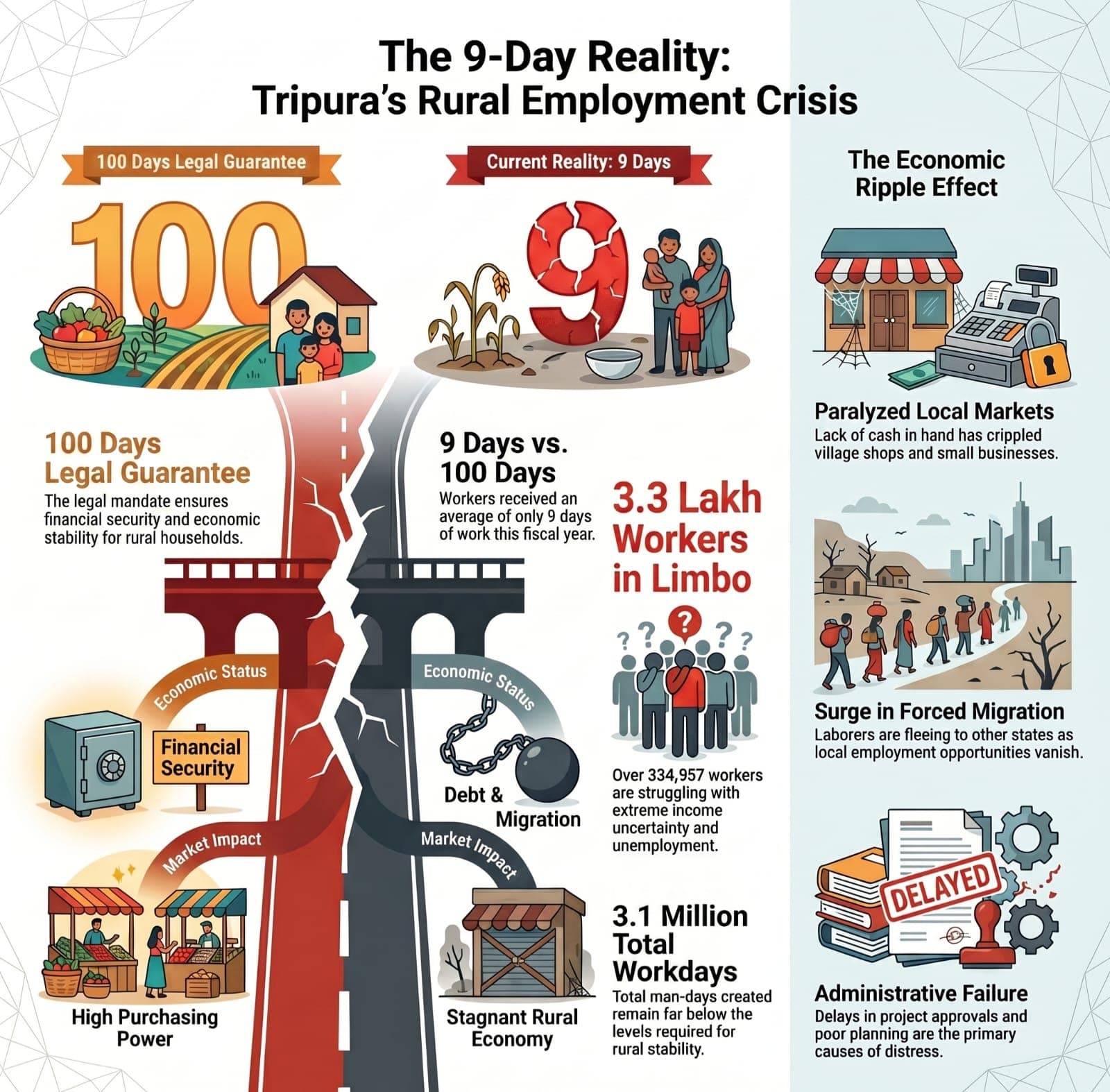
Official data released by the Union Ministry of Rural Development shows that employment generation under the Mahatma Gandhi National Rural Employment Guarantee Act (MGNREGA) in Tripura remains significantly below expectations during the current financial year. As of June 9, 2026, a total of 3,34,957 workers have received employment under the scheme. However, only 31,27,611 person-days of work have been generated, resulting in an average of just 9 days of employment per worker. This figure is far below the scheme's objective of providing up to 100 days of guaranteed wage employment per rural household annually.
When? The figures relate to the financial year 2026–27, covering the period from the beginning of the financial year up to June 9, 2026.
Why Is This Significant? MGNREGA serves as one of the most important sources of employment and income support for rural households, particularly during: • Agricultural off-seasons • Periods of economic hardship • Times when local employment opportunities are scarce For many families in rural Tripura, the scheme acts as a safety net that helps sustain livelihoods. The low average of 9 workdays has therefore raised concerns about whether the scheme is fulfilling its intended role.
How Was This Calculated? According to official data: • Total workers employed: 3,34,957 • Total person-days generated: 31,27,611 When total person-days are divided by the number of workers employed, the average comes to approximately 9 days of work per worker.
Impact on Rural Workers Villagers across various regions report that MGNREGA remains one of the few reliable sources of income available to rural households. With limited employment opportunities under the scheme: • Daily wage earners are receiving fewer workdays. • Household incomes are declining. • Many workers are reportedly migrating to other states in search of employment. • Economic uncertainty is increasing among low-income families.
Impact on the Rural Economy The effects extend beyond individual workers. Reduced employment means reduced spending power in villages, which affects: • Small grocery stores • Tea stalls • Agricultural input suppliers • Local transport services • Other small businesses Lower cash circulation in rural areas has reportedly contributed to a slowdown in local economic activity.
What Do Economists Say? Economists note that MGNREGA is more than just an employment programme. The scheme also: • Injects cash into rural economies. • Supports local markets. • Sustains small businesses. • Helps maintain economic activity during difficult periods. Therefore, lower employment generation can create ripple effects across multiple sectors of the rural economy.
Questions Over Project Implementation Experts point out that Tripura still has numerous potential projects that could generate employment, including: • Rural road construction • Drinking water infrastructure • Irrigation projects • Pond renovation • Soil conservation works • Other community asset creation activities Given the availability of such work, concerns have emerged over why person-day generation remains so low.
Possible Reasons Behind the Shortfall Reports indicate several factors that may be contributing to the situation: • Delays in project approvals • Slow execution of approved projects • Administrative and coordination gaps • Procedural bottlenecks at the field level • Delayed job allocation to workers In several areas, workers are reportedly waiting for work while projects remain stalled or pending.
Rising Cost of Living Adds Pressure The employment shortfall comes at a time when rural households are already facing increasing expenses. Prices of essential commodities and services continue to rise, including: • Rice • Lentils • Cooking oil • Medicines • Educational expenses Reduced income combined with rising costs is placing additional financial pressure on daily wage-dependent families.
What Are the Major Concerns? Key concerns emerging from the data include: • Average employment remains at only 9 days. • The state may struggle to approach the 100-day employment objective by the end of the financial year. • Migration of rural workers may increase. • Rural purchasing power may continue to decline. • Economic activity in villages could weaken further if employment generation does not improve.
Key Questions Being Raised 1. Why has average employment remained at only 9 days per worker? 2. Are project planning and implementation mechanisms functioning effectively? 3. Why are available infrastructure projects not generating more employment? 4. What administrative bottlenecks are delaying work allocation? 5. Can the state significantly increase employment generation during the remaining months of the financial year? 6. Is MGNREGA functioning as an effective employment guarantee programme on the ground?
The Core Issue The official figures have intensified debate over whether MGNREGA in Tripura is effectively delivering employment at the scale intended under the scheme. With rural distress, migration pressures, and rising living costs becoming increasingly prominent concerns, the central question remains whether meaningful employment opportunities will reach rural households in practice or continue to fall short of expectations.